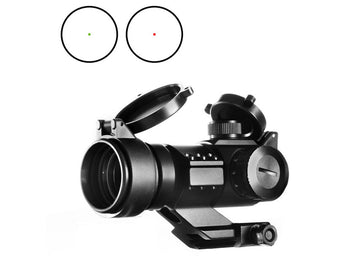

Open red dots
Open-emitter red dot: the emitter projects the dot onto an exposed lens, with no closed tube surrounding it.
How it differs from a closed red dot
The open design provides a wider field of view for the same footprint and lower weight, as there is no tubular body. This is why it dominates in dynamic shooting and handgun use.
The trade-off is exposure: rain, mud and snow can settle on the surface that generates the dot, causing the reticle to blur until cleaned. In harsh environments or for extended outdoor use, a closed red dot is worth considering.
How to choose
The dot size in MOA is the primary criterion: a large dot, 4 or 6 MOA, is picked up instantly at close range; a smaller one, 2 or 3 MOA, covers less of the target at one hundred metres. The window determines how much you see around the sight, and matters during transitions between targets.
Check the mounting footprint before ordering: RMR, Docter, ACRO, MOS and RMSc are not interchangeable. Bases and adapters can be found in the mounts section.